

What is Codeaid?
Codeaid is an online coding assessment platform built specifically for companies hiring machine learning engineers, data scientists, and AI developers. Unlike generic coding tests, it focuses on domain-specific challenges in Traditional ML, Deep Learning, Generative AI, NLP, and Computer Vision. Assessments are auto-scored on model accuracy and code quality, so you can screen candidates at scale without scheduling technical interviews.
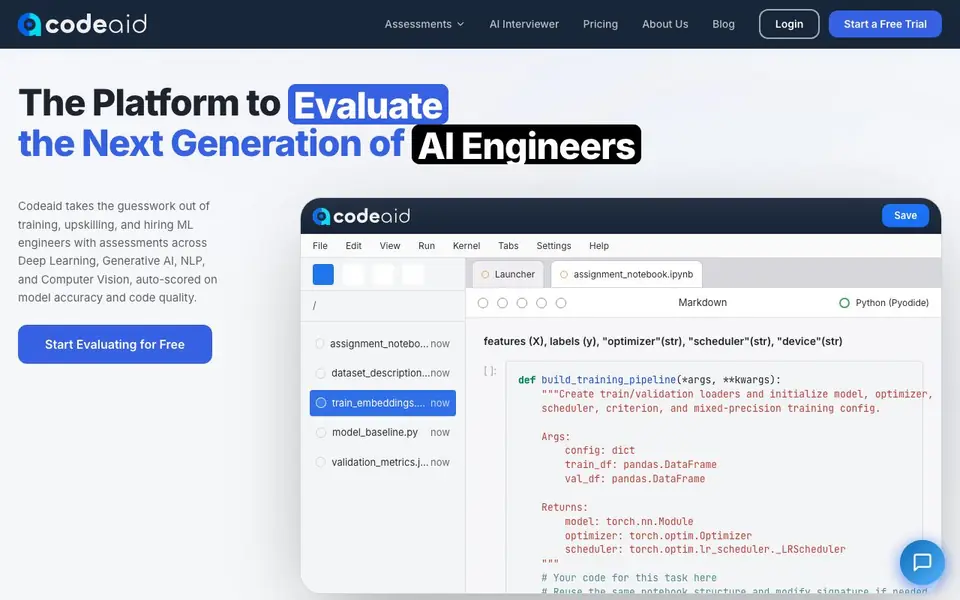
You start by creating an assessment that fits your needs. Use the AI Interviewer to define questions, adjust difficulty, and generate realistic ML and AI tests in minutes. Test takers work in interactive notebooks or container-based environments that mirror real workflows, handling data, building models, debugging pipelines, and improving performance. You can also design assessments around modern AI frameworks like LangChain and AutoGen.
Codeaid suits both hiring and developing your existing team. It helps you evaluate engineers who can actually build, not just pass theoretical exercises. The platform covers a range of AI domains and offers a free trial to get started.
Codeaid features
- Domain-specific assessments: Tests cover Traditional ML, Deep Learning, Generative AI, NLP, and Computer Vision.
- Auto-scoring: Evaluates model accuracy and code quality automatically for faster hiring decisions.
- Realistic environments: Test takers work in notebooks or containers that mirror on-the-job workflows.
- AI Interviewer: Generates tailored assessments and adjusts difficulty levels in minutes.
- Framework support: Create tests involving LangChain, AutoGen, and other agent-based systems.
What you can do with Codeaid
- Screen machine learning engineer candidates at scale without scheduling interviews.
- Evaluate data scientists on realistic model-building and debugging tasks.
- Upskill your existing team with domain-specific AI assessments.
- Generate custom coding tests for generative AI or computer vision roles.
How to get started with Codeaid
- Start a free trial from the Codeaid website.
- Use the AI Interviewer to create an assessment or choose an expert-designed one.
- Invite candidates to complete the test in a realistic notebook or container environment.
Tips for better results with Codeaid
- Use Codeaid's AI Interviewer to define your exact role requirements and difficulty level, then let it generate domain-specific tasks that match your team's real ML workflows.
- Design assessments around your actual stack by including frameworks like LangChain or AutoGen, so you evaluate candidates on the tools they will use in production.
- Review the auto-scoring report on model accuracy and code quality together, not just pass/fail, to identify candidates who optimize performance and write maintainable code.
- Run a trial assessment with your current team first to calibrate question difficulty and scoring thresholds before using Codeaid for external hiring decisions.
Codeaid pricing
Codeaid offers a free trial before you pay. Check codeaid.io for current plans.
What to check before you rely on Codeaid
- Check whether the free trial includes full access to all assessment domains and auto-scoring features, since the website does not list trial limitations.
- Verify if Codeaid supports your preferred notebook or container environment, as the site shows interactive notebooks but does not specify all integration options.
- Confirm how candidate data and assessment results are stored and protected, because the website does not state its data privacy or retention policies.
Who Codeaid is for
Codeaid suits hiring managers, HR teams, engineering leaders and AI recruiters. If that is not you, the AI business tools below may fit better.
Similar tools compared with Codeaid
| Tool | What it is | Pricing |
|---|---|---|
| Codeaid | Coding assessment platform for AI engineers | Free trial |
| Tidio | AI customer service and sales platform | Freemium |
| Chatbase | AI customer experience and support agents | Free trial |
| Copy.ai | AI-native go-to-market platform | See website |
| Harvey | AI platform for legal and professional services | See website |
Codeaid FAQ
What does Codeaid assess?
Codeaid assesses AI and ML skills across Traditional ML, Deep Learning, Generative AI, NLP, and Computer Vision. Tests are auto-scored on model accuracy and code quality, focusing on real-world workflows.
Is there a free plan?
Codeaid offers a free trial, as stated on its website. You can start evaluating for free, but the site does not detail specific free plan limits or paid tiers.
Who is Codeaid for?
It is for companies hiring machine learning engineers, data scientists, and AI developers. It also helps teams upskill existing engineers with domain-specific assessments.
How do test takers complete assessments?
Test takers work in interactive notebooks or container-based environments that mirror real AI workflows. They handle data, build models, debug pipelines, and improve performance, similar to on-the-job tasks.
What integrations or exports does Codeaid support for assessment results?
The Codeaid website does not mention specific integrations or export options for assessment results. To find out what is available, check the platform's documentation or contact their support team directly. You can also explore the tool during the free trial to see what export features are offered.
On which devices or platforms can Codeaid assessments be taken?
Codeaid assessments run in interactive notebooks or container-based environments, which are accessed through a web browser. The website does not specify particular operating systems or devices, but since it is browser-based, you likely need a computer with a modern browser and internet connection. Check the platform's system requirements during the trial for more details.
Does Codeaid require test takers to create an account?
The Codeaid website does not state whether test takers need to create an account. Typically, coding assessment platforms send unique links to candidates, but you should verify this by starting a free trial and inviting a test taker to see the process. The platform's documentation or support can also clarify the exact requirements.


