

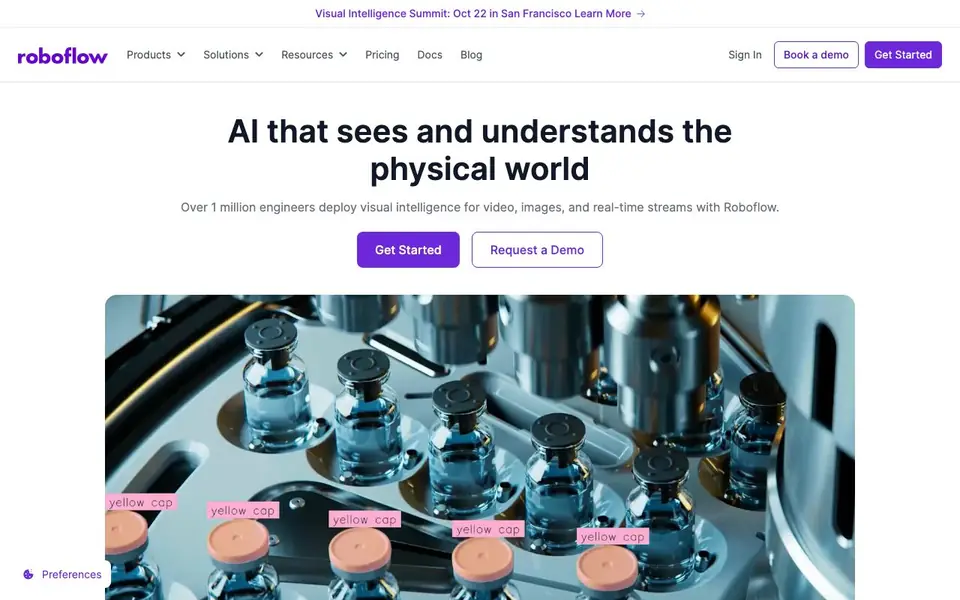
What is Roboflow?
Roboflow is an end-to-end platform for computer vision. It helps you go from an idea to a deployed application. You can use the latest foundation models or fine-tune them for your specific needs. Over 1 million engineers and 16,000 organizations use it, including over half of the Fortune 100.
You start by uploading or annotating your images and videos. Roboflow provides automated annotation tools to speed up labeling. Then you train or fine-tune a model, chain multiple models, add custom logic, and integrate with your pipeline. Finally, you deploy to scalable cloud infrastructure or edge devices.
It suits developers and enterprises in industries like logistics, manufacturing, healthcare, and retail. The platform includes an open-source deployment solution called Roboflow Inference. You can start running models in about two minutes with a simple pip install. The website highlights customer stories from BNSF Railway, USG, and Fletcher Sports.
Roboflow features
- Automated annotation: Speed up labeling of images and videos for training datasets.
- Foundation models: Use the latest pre-trained models or fine-tune them for your needs.
- Multi-model chaining: Combine several models and add custom logic to turn predictions into actions.
- Cloud deployment: Run inference on scalable cloud infrastructure without managing servers.
- Edge deployment: Deploy models across a fleet of edge devices for real-time processing.
What you can do with Roboflow
- Automate yard inventory and train wheel inspections for freight operations.
- Track fast-moving players to deliver broadcast coverage at sports events.
- Monitor manufacturing lines to prevent downtime and ensure product quality.
- Build custom vision applications for healthcare, retail, or robotics.
How to get started with Roboflow
- Sign up on Roboflow's website and create a project.
- Upload images or videos and use automated annotation tools to label them.
- Train or fine-tune a model, then deploy it to cloud or edge with Roboflow Inference.
Tips for better results with Roboflow
- Start with Roboflow's automated annotation tools to label a small sample of images, then review and correct the outputs before scaling to your full dataset.
- Use Roboflow's foundation models as a baseline, then fine-tune them on your specific data to improve accuracy for your unique use case.
- Chain multiple Roboflow models with custom logic to turn raw predictions into actionable outcomes, such as triggering alerts or filtering results.
- Deploy your trained model to edge devices with Roboflow Inference to reduce latency, but test on your target hardware early to catch compatibility issues.
Roboflow pricing
Roboflow’s homepage does not list prices. Check roboflow.com for current plans.
What to check before you rely on Roboflow
- Check whether Roboflow's free tier covers your expected data volume and training runs, as the website does not list specific limits or pricing details.
- Verify that Roboflow supports the image and video formats you plan to upload, since the site does not enumerate all accepted file types.
- Review Roboflow's data privacy and security policies for your project's compliance needs, as the website does not detail data handling for all plans.
Who Roboflow is for
Roboflow suits machine learning engineers, developers, enterprise teams and computer vision researchers. If that is not you, the AI developer platforms below may fit better.
Similar tools compared with Roboflow
| Tool | What it is | Pricing |
|---|---|---|
| Roboflow | Computer vision platform for developers | See website |
| SiVideoAPI | Unified API for top AI video models | Freemium |
| OpenSI | AI model comparison and pricing tool | See website |
| OpenRouter | Unified API for many AI models | Freemium |
| Ollama | Run open models locally or cloud | Freemium |
Roboflow FAQ
What does Roboflow do?
Roboflow is a platform for building and deploying computer vision models. You can annotate data, train or fine-tune models, and run them in the cloud or on edge devices. It handles images, video, and real-time streams.
Who is Roboflow for?
It is designed for developers and enterprises. The website mentions over 1 million engineers and 16,000 organizations using it, including over half of the Fortune 100. Industries include logistics, manufacturing, healthcare, and media.
How fast can I start running a model?
Roboflow says you can start running models in about 2 minutes with Roboflow Inference. You install it with pip and then run a simple command to start the server and load a model.
Does Roboflow offer a free plan?
The website does not state pricing details on the homepage. You can check the Pricing page or book a demo to learn about plans and free options.
What can Roboflow export or connect to?
Roboflow lets you integrate with your pipeline and deploy to cloud or edge devices. The website mentions chaining models and adding custom logic, but it does not list specific export formats or third-party integrations. Check the docs or pricing page for details on integrations and deployment options.
On which devices or platforms does Roboflow run?
Roboflow runs on scalable cloud infrastructure and across a fleet of edge devices for real-time processing. The website highlights edge deployment for manufacturing and sports, but it does not specify which operating systems or hardware are supported. See the documentation for device requirements.
Does Roboflow require an account to use?
The website shows a 'Sign In' button and a 'Get Started' option, which suggests you need an account to use Roboflow. However, the site does not explicitly state whether an account is required for all features. Visit the sign-up page to see the account creation process.


