

What is Haystack?
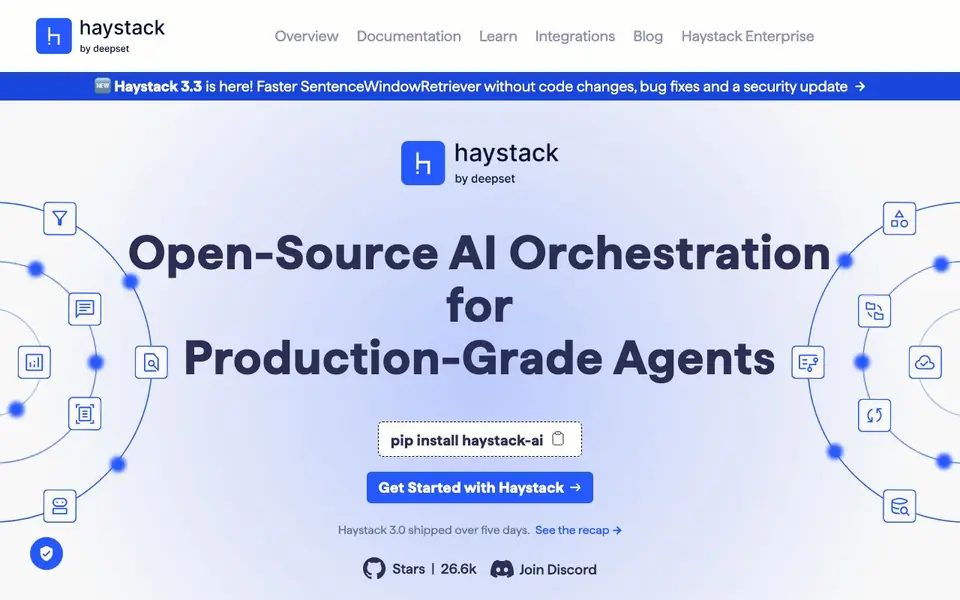
Haystack is an open-source AI orchestration framework for building production-ready, LLM-powered agents and applications. It gives you modular building blocks to orchestrate every step of an AI agent, from retrieval to reasoning, memory, and tool use. You get full visibility to inspect, debug, and optimize each decision your AI makes.
You start by installing Haystack with pip and then assemble components into pipelines. You can connect to OpenAI, Anthropic, Mistral, Hugging Face, Weaviate, Pinecone, Elasticsearch, and more. The open architecture lets you mix and match components freely, with no vendor lock-in. Pipelines are serializable, cloud-agnostic, and Kubernetes-ready, with logging and monitoring support.
Haystack suits developers who need to move from prototype to production using the same building blocks. It covers use cases like advanced RAG, AI agents, content generation, multimodal AI, and conversational AI. For extra support, there is an enterprise platform with visual pipeline design, secure access controls, and scalable deployment options.
Haystack features
- Modular pipelines: Compose reusable components to build custom AI workflows.
- Context engineering: Control retrieval, reasoning, memory, and tool use in agents.
- Multi-provider integration: Connect to OpenAI, Anthropic, Mistral, Hugging Face, and more.
- Production readiness: Pipelines are serializable, cloud-agnostic, and Kubernetes-ready.
- Observability: Built-in logging and monitoring to debug and optimize AI decisions.
What you can do with Haystack
- Build advanced RAG pipelines with hybrid retrieval and self-correction loops.
- Design production-ready AI agents with standardized tool calling.
- Create content generation engines using Jinja-2 templates.
- Architect multimodal AI apps for image processing and audio transcription.
How to get started with Haystack
- Install Haystack with pip install haystack-ai.
- Assemble components into pipelines for your use case.
- Deploy to production with unified tooling for testing and shipping.
Tips for better results with Haystack
- Install Haystack with pip install haystack-ai and start with a simple pipeline before adding complex components. Test each stage individually to isolate issues early.
- Use Haystack's serializable pipelines to save and reload your workflows. This makes debugging and iterating faster when you need to tweak retrieval or generation logic.
- Mix and match providers like OpenAI and Hugging Face in Haystack to compare outputs. This helps you find the best model for your use case without committing to one vendor.
- Leverage Haystack's built-in logging and monitoring to trace each decision in your agent. Inspect the logs to spot where retrieval or reasoning fails and adjust accordingly.
Haystack pricing
Haystack has a free way to start, with paid plans for heavier use. Check haystack.deepset.ai for current limits and prices.
What to check before you rely on Haystack
- Check the pricing page for Haystack Enterprise because the website does not list specific prices. Confirm whether your usage fits the free open-source tier or requires paid support.
- Verify which integrations you need are supported in your Haystack version. The website lists many providers, but not all may be available in the latest release.
- Review the data privacy terms for your chosen providers and deployment. Haystack is cloud-agnostic, but your data handling depends on the services you connect to.
Who Haystack is for
Haystack suits developers, AI engineers, data scientists and tech teams. If that is not you, the AI developer platforms below may fit better.
Similar tools compared with Haystack
| Tool | What it is | Pricing |
|---|---|---|
| Haystack | Open-source AI orchestration framework | Freemium |
| SiVideoAPI | Unified API for top AI video models | Freemium |
| OpenSI | AI model comparison and pricing tool | See website |
| OpenRouter | Unified API for many AI models | Freemium |
| Ollama | Run open models locally or cloud | Freemium |
Haystack FAQ
What is Haystack?
Haystack is an open-source AI orchestration framework. It helps you build production-grade agents and applications powered by LLMs using modular, composable building blocks.
Is Haystack free to use?
Haystack is open-source, so the core framework is free. There is also an enterprise platform with paid support and additional features, and you can try the enterprise platform for free.
Who is Haystack for?
Haystack is for developers and teams building AI systems. It suits those who need to move from prototypes to production with full control over their AI workflows.
What can you build with Haystack?
You can build advanced RAG pipelines, AI agents, content generation engines, multimodal AI apps, and conversational AI bots. The framework supports various retrieval and generation strategies.
What integrations does Haystack support?
Haystack connects to OpenAI, Anthropic, Mistral, Hugging Face, Weaviate, Pinecone, Elasticsearch, and more. You can mix and match components freely without vendor lock-in. For a full list, check the Integrations section on the Haystack website.
Does Haystack run on any platform or cloud?
Haystack pipelines are serializable, cloud-agnostic, and Kubernetes-ready. This means you can run them on any cloud or on-premises environment. The website mentions deployment guides to help you set up production workloads across various platforms.
What does the free plan of Haystack include?
Haystack is open source, so you can install it with pip and use the framework for free. The website does not detail a separate free plan beyond the open-source version. For enterprise features like visual pipeline design or secure access controls, you would need the paid platform.


